Back To Normal
Welcome To Financial Freedom
Showing posts with label content. Show all posts

3 Brand New Ways Your Business Can Use Pinterest

Did you know that, on average, the half-life of a single Pinterest pin is three and a half months – more than 1,600 times longer than a Facebook post? Or were you aware that 84% of female Pinterest users who signed up for the service four years ago are still using the site – and are apparently growing more active over time?

As Shareaholic’s most recent Social Media Referral Report showed, Pinterest is still the reigning queen of social traffic, second only to Facebook. But in my opinion, second place is a small price to pay for content that lasts forever and users that grow more dedicated as the years pass.
If there is any lesson your business can learn from these statistics, it is this: If you are not already using Pinterest to your advantage, you should start now.

3 Brand New Ways Your Business Can Use Pinterest image pinterest tablet
There’s a stigma that Pinterest is only for wedding planning or cupcake recipes, but it is not. Pinterest is for anyone who wants to create a collection. And that collection can serve several purposes – it can be for future purchases, inspiration or recommendations for others.
Related Resources from B2C
“But I don’t want another social media account!” you may say. “I have enough as is!”

Surprise! You’re Already on Pinterest

Even if you do not already have an active presence on Pinterest, chances are high that your content has been pinned there anyway. You can check this out for yourself by accessing the following URL: http://www.pinterest.com/source/YOUR-URL

For example, this is what I see when I search the WebpageFX site on Pinterest:


3 Brand New Ways Your Business Can Use Pinterest image webpagefx pins 600x342

If I wasn’t monitoring our Pinterest presence, I would have known about only a few of those pins – three of which I pinned myself, either under my personal account or our brand account – but none of the others. What if someone had asked a question or pointed out a typo on an infographic and I wasn’t paying attention?

Since your content is already on Pinterest, my suggestion is this: Invest the amount of time into the platform that best suits your needs. You don’t have to use it as a social media platform, setting up boards and pinning your own content. Instead, you can use it to reach your customers, strengthen your content marketing, or even do a little research.

Here are three unique ways any business can effectively harness the power of Pinterest.

The First New Way to Use Pinterest: Brand Strengthening

Establishing a profile and boards on Pinterest is one way you can strengthen your brand. However, you do not necessarily need to establish an active profile, pinning your content day and night, to improve your Pinterest presence.

Honestly, if you are really busy, you can let users do the pinning for you. But pay attention – and step in to say thanks, address problems, or just be an all-around awesome person.

This is what I recommend for every business:
  1. Set up an account for your brand and populate as much or as little content as you like.
  2. Bookmark the URL search I mentioned earlier, searches for your brand name, searches for your product names, and so on.
  3. Check these bookmarks regularly.
  4. Comment on pins where your brand is mentioned.
I don’t see a lot of brands doing #4 even occasionally, and I have to admit… it drives me kind of crazy. Why would you not thank someone for going out of their way to pin something from your site, along with a nice, thoughtful comment?
I poked around the feeds and site searches of a bunch of brands I follow until I finally found a local company, Havahart (they make humane animal traps, a must-have for someone whose backyard is full of raccoons that like to scare their dog and knock over trash cans at 4am), that regularly does this on user pins:
3 Brand New Ways Your Business Can Use Pinterest image havahart
This kind “thanks!” message probably went a long way. Yet I don’t see enough brands thanking even 1% of their customers for spending hundreds of dollars on clothing or shoes.

This is an under-utilized strategy that can really pay off in the long run. Customers appreciate being acknowledged and appreciated. You do not have to populate your profile to use Pinterest – just be there and pay attention.

The Second New Way to Use Pinterest: Content Curation

“Content curation” is one way brands choose to supplement their existing social media or blogging activity. Basically, share content created by others so your audience does not get bored or annoyed reading your content all the time.

Pinterest can be an absolutely amazing source of content. Whether you’re looking for a cheerful image to share on your Facebook page or something to help fill in an empty spot in a blog post, the site’s search tool is bound to dig up an excellent image which is linked right back to the source.

Let’s say you write about DIY phone accessories, but you are fresh out of ideas. If you hop on Pinterest, you may see this:

3 Brand New Ways Your Business Can Use Pinterest image pin charger
Perfect, right?

If you click through from this pin, you’ll end up at the source, and you can include the blog post this pin is from as part of your curation on Twitter, Facebook, and so on. (Remember: Always credit the creator, not the pinner!)

The Third New Way to Use Pinterest: Market Research

This was honestly my favorite way to use Pinterest for the first year or two of its existence, just around the time it began exploding as a mainstream social network. Everyone pinned everything. The site was full of products, recipes, ideas… and people.

Pinterest is, even for the most boring, dull and super-niche B2B manufacturers out there, a prime opportunity to conduct market research.

You can accomplish in minutes what some formal research projects might take days, weeks or months to do. Armed with a hint of knowledge, a short block of time, and an interest in what your customers or leads want and need, you can discover spectacular things that will help grow your business.

Think of it this way: You run an e-commerce store and are deciding where to place remarketing ads, but you have no idea where your target audience shops, other than with you. To find out, you simply need to:
  • Find one of your customers — or someone who looks like your ideal customer — on Pinterest.
  • Review the sites they consistently pin from.
  • Identify sites that align with your marketing messages and goals.
Simple, right? So if your store sells baking supplies, you may repeat this exercise 6-7 times to discover that your customers frequently pin content from from Modcloth. At that point, it is worth investigating whether or not Modcloth sells ad space with which you can run a remarketing campaign. Note: Modcloth does not. Back to the drawing board, then.

You may also do informal research related to users’ wants, needs, and desires. Sticking with our baking supplies example, if you are on the hunt for ideas for new mixing bowls, you could search Pinterest for “mixing bowls” and read the user comments. These can sometimes be an absolute gold mine for user feedback, or pain points that can lead to you making an amazing new product.

Perfect example:
3 Brand New Ways Your Business Can Use Pinterest image mixing bowls 559x600
“Anyone know how to fix a bowl that has lost its color?” Right there is a pain point, a customer problem, that you might be able to fix.

If it looks like a lot of users are complaining about the color chipping or scraping off their bowls in the dishwasher, you can try to develop a solution. This is the kind of complaint you might only find on Pinterest, where users seek help from one another in an honest and true fashion.

Pinterest Can Be Beneficial to Everyone

Although some businesses may be tempted to dismiss Pinterest as a run-of-the-mill social site, or have spent the last few years just scraping by with the occasional pin or new board, there are many amazing opportunities for brands that take the time to realize its full potential.

For starters, you may choose to jump in and interact with users pinning your products. Others would find it worthwhile to use Pinterest’s powerful search to strengthen content curation strategy. Many businesses may benefit from real-time market research.

Ultimately, there is a lot to gain by trying any of the above methods. Which one sounds most appealing to you?]

Have any ideas for another new way to use Pinterest? Have you tried any of these tactics in the past? I would love to read your thoughts in the comments!

Read more at http://www.business2community.com/pinterest/3-brand-new-ways-business-can-use-pinterest-0966633#mCs0IEFct41TVip2.99
Read More


6 Qualities to Make Your Videos Go Viral


Viral content is highly coveted, but getting your videos to go viral is no easy feat. Highly sharable content can give your business a lift, leading new people back to your site and increasing conversions. Creating a viral video, however, is far from easy.

Having a piece of content go viral is like winning the Internet’s version of the lottery. It’s incredibly difficult to achieve and often hard to replicate. For every viral video success, there are dozens, if not hundreds, of failures. Even Upworthy, the king of virality, only has 0.3 percent of posts going viral.
But there are still actions you can take to improve your odds of viral success. Help your company reap the benefits of video with these six tactics to help your videos go viral:

Be Short and Sweet
Keep in mind, you’re creating content for the 140 character Twitter generation. Our attention spans are getting shorter and shorter, which means it’s time to tighten up your video content. A survey published in The New York Times found more than 19 percent of people had left a video after only 10 seconds. By a minute in, the video had lost a staggering 44 percent of viewers.

Since you’ll lose almost half of your audience by the end of minute one, put your most interesting, fascinating, funny, or surprising information first and foremost in your video. Creating viral video content is one place where you never want to save the best for last.

Be Upbeat
Jonah Berger, author of the book Contagious: Why Things Catch On, found the most highly sharable content tended to evoke strong emotions in the reader or viewer. And of those emotions, the most sharable content tended to be that which had a positive or upbeat note. Using empirical research, Berger and UPenn Professor Katherine Milkman found happy emotions tended to outperform sad emotions in the realm of sharability.

To be sharable, content needs to strike an emotional chord in viewers. These same viewers are more likely to share upbeat content, so if you want your videos to go viral, it’s important to strive for a positive spin.

Be Timely
If you want your videos to make the jump to virality, it might be time to brush up on your current events. By hooking into an existing Internet meme or popular topic, you increase the odds your content will be viewed and shared by those already interested in the topic.

This can be anything from a current event in the world, to a pop culture topic dominating the news. For example, just look at how many parodies of popular entertainment like Game of Thrones and Frozen exist on video channels. If you speak the same language as your target audience and present interest in the same topics, they’ll be more likely to share your content.

Be Involved
One of the keys to virality is engagement. Engaging with an audience can lead to loyalty and interest. After all, everyone likes to be heard. This is the approach taken by companies like Old Spice in several of advertising campaigns.

At one point, the Old Spice man, played by actor Isaiah Mustafa, answered fan questions on social media in short YouTube videos. Adding an engagement portion to your videos, like answering viewer questions, can give your content a boost and make it more sharable.

Be Informative
Your audience is always searching for new information and better ways to perform everyday tasks. If your video content is interesting and informative, it is also highly sharable. Everyone wants to learn something they didn’t already know, and videos can be a great tool for curating top-notch information.

At my company Pluto.TV, we curate the best videos for viewers, whether they’re looking for world news or cat videos. You need to take a similar approach to your videos, and curate the best and most informative content to surprise and inform your viewers.

Be Inspiring
By now, the incredible story of Upworthy’s success is old news. The site skyrocketed to more than six million unique page views per month in its first year, thanks in part to its famous (and infamous) headlines. Another reason is because the site looks to find inspiring stories to share with their large readership.

To get the viral edge you want, look for stories to inspire your readership, whether it’s a story of overcoming struggle, standing up in the face of adversity, or just finding success. Audiences love a good inspirational story, and the more inspirational it is, the more your audience will want to share it with others.

Creating viral videos isn’t easy — if it was, every business would have a few viral hits. These six pieces of advice can help you improve your content’s sharability and quality, improving your odds at viral success. See more:

What are your tips for creating viral videos? Share in the comments!

Read More


All Your Content Doesn't Matter Without Meaning

Photo: Your Content Doesn't Matter Without Meaning http://linkd.in/1kvXJKJ by Bill Sebald 

I've heard the best time to write is very early in the morning when you're still in mode. It may help with creativity or in developing concepts. It might even help you spend less mental energy (who couldn't use more battery life?). Not to mention, the only likely distraction are roosters, though only a problem for marketers working on farms.

For our SEO clients, I often write my titles after my piece is written, but I never go into a content piece without a purpose. And more than a fluffy idea, but an idea that I can qualify as valuable. I wrote a post on Moz about uncovering some of these ideas and measuring the value of them. I truly believe this extra work ahead of time pays out in the end (read the post to pick up some tips of finding and validating content ideas with data).

Once your past the data and have some direction, you're entering the vicinity of the art form known as writing. Semiotics, philosophical theorizing, and representation make your content constructive. If you're teaching your audience from the place they reside, you're going to make an even bigger impact. If you don't know your audience and you're talking over their heads, you're going to whiff.
Sounds logical, right? The truth is, Google loves this type of content. It's exactly what they want to be ranking since it improves their brand.

But what I'm still seeing from businesses and content vendors alike are fluffy pieces that are redundant to what's already been said, cranked out by the thousands, in hopes of winning SEO traffic. I'm also hearing about those uncomfortable conversations between the business and the vendors when the content does absolutely nothing in terms of SEO progress. Sure, they may be written fine, but they are as memorable as Teen Wolf Too.

Panda updates are designed to de-rank thin content. But thin content isn't just the stuff that's spun, regurgitated, and published in short chunks. Long form content may be less likely to be suppressed by Panda, but if it's not saying anything, Google's not going to go for it (at least not for the long term - that's a pretty safe bet).

See, Google - through the Hummingbird update - has improved its comprehension. It's improving its use of structured data and semantics, and is trying to determine the value of content beyond just keywords. Even though we're just at the beginning, I can definitely see a day where keywords alone don't move the needle effectively. We're already entering this phase with pages being ranked even if they don't contain a keyword, and results understanding the intent of the search based on previous search data and relationships. More signals outside of the mainstream SEO keyword plays.
This is the mental checklist I audit my content ideas against, then audit my final copy against:
  • Did I say anything new?
    If not, it's probably better to be a curator, but don't expect much from SEO here.
  • Did I say something that will get someone's attention?
    This is marketing - if you're writing the same old stuff or failing to cut through the noise, you're not doing effective marketing. Yup - digital has raised the bar quite high.
  • Is the content part of a strategy?
    If you're posting to get search traffic, that's not a strategy - that's a tactic. If you're using a bunch of tactics chained together with a beginning and an end, with a specific, calculated goal, that's a strategy. Normally the strategy has a bigger impact in Google today.
  • Am I really an expert in this topic?
    If you're not, people will know. They won't share. They won't comment. They won't link. You probably won't get Google's attention then. Fill your content with your expertise, even if you have to become an expert before you put pen to paper.
  • Did my copy focus on relationships Google knows about?
    This one is certainly tougher, but a tool like Alchemy API might help you hit the triggers that Google uses to grade your content.
If your site is cranking out non-spammy, well-written 500+ articles because "content is king," but not really saying anything that makes your brand a brand, or gives your users a different point of view, or solves their problems, you're underwater. You may not have thought of it this way, but reaching the surface may be harder than you realized. Plain content isn't king anymore.
 
Hopefully I gave you something to think about. Fire your "boring content pumping machine" and replace it with real content strategists who feed on data. This might ultimately wind up giving your brand a deserved face-lift.

Give your content meaning. Give it a purpose. Give it a home where it's less crowded. Give it a real chance to swim. See more

Read More


How Facebook Calculates What Appears In Your News Feed

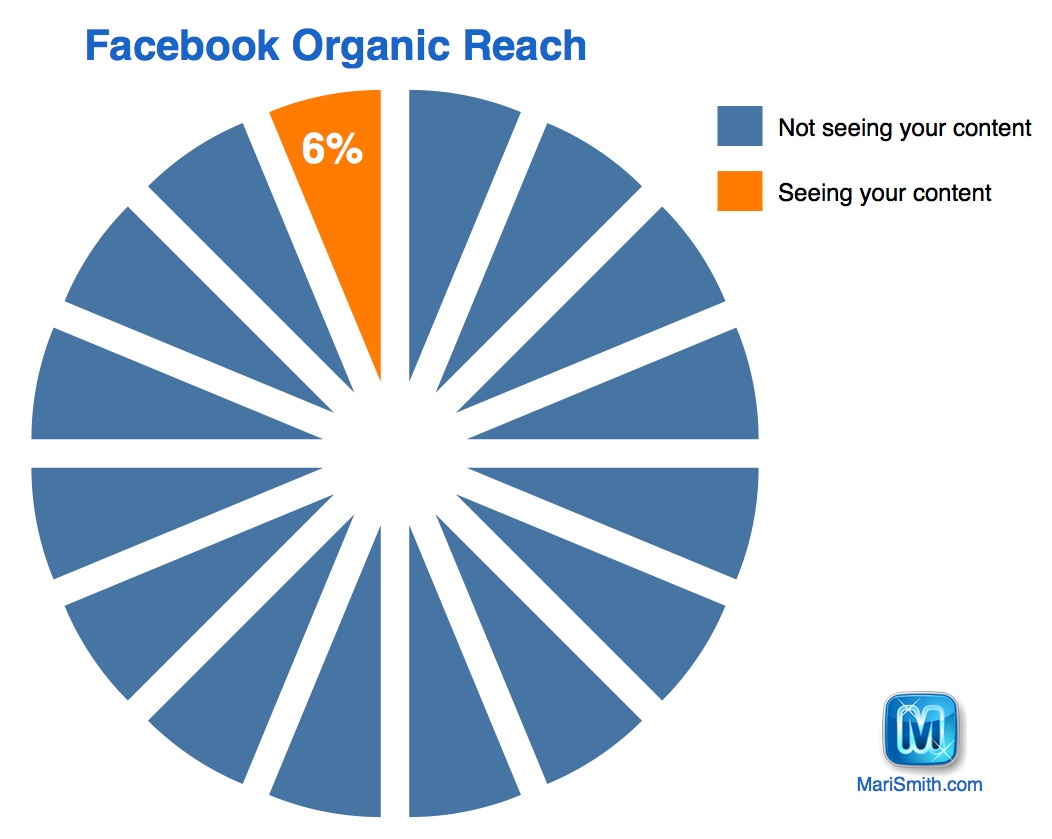
The problem with Facebook organic reach can be summed up in one single graphic: Only 6 percent of your fans are seeing your content in their news feed. The other 94 percent are not.

Facebook Organic Reach six percent

Some sources indicate that organic reach may drop to 1-2 percent in the near future. Others say it’s destined to hit zero; it’s only a matter of time.
These stats are a big drop from the already low 16 percent that Facebook indicated back in April 2012.

What is causing the decline in organic reach?

The simplest answer is there is a significantly greater amount of potential content flooding into our news feeds on a daily basis. This bigger firehose of content is caused by several factors, including:
  • The average number of Facebook friends users have is 338 (that’s a big increase compared to 130 back in 2008).
  • 15 percent of Facebook users have more than 500 friends.
  • There are between 1500 and 15,000 pieces of content that Facebook could potentially show in your news feed each time you log on to the site!
  • The Facebook news feed ranking algorithm (some folks call this formula ‘EdgeRank’) uses more than 100,000 weights* to determine what you’ll see.
  • Ultimately, out of the 1,500 – 15,000 potential stories, Facebook passes them through the mega algorithm and displays approximately 300 stories in your feed.
*Examples of weights: how many mutual friends like the person/page/content, how often you interact with the person/page, when the post was published, when the last comment was made, what types of content you typically interact with: watch more videos and Facebook will show you more videos, like more links and Facebook will show you more links. 

Embrace pay-to-play

Up until around mid 2013, business users had a wonderful free ride on Facebook for about six years. Now, Facebook is definitely pay-to-play. Thing is, let’s compare getting into the news feed of more of your Facebook fans to getting on page one of Google.
If you were to set your sights on being among the TOP organic search results on Google for your best keywords, do you think that would cost you money to do so? Absolutely!
You’d need to hire an experienced SEO company and invest quite a bit of time to see results. Sure, you might get lucky and get instant indexing for a top keyword… but can you sustain that over time? Likely not. Good organic search engine results takes time…and money. It’s the same with good Facebook news feed visibility now.  It takes time to find the right style, topics, cadence and interaction with your audience. You’ll pay to boost/promote some content and sometimes it can be hit or miss. Keep persisting, though.

Can you still get a spike in organic reach?

On my own Facebook page (currently with over 134,000 fans/likes), I used to regularly see organic reach in the 50,000 range.
Then, that started dropping in the fall of 2013; my average reach in Q4 was down to 33,000. And by the end of Q1, 2014, I was seeing an average organic reach of just 8,500. :( Ouch, I know. Fortunately, I’ve seen it bounce back up a bit over the past few months with the additional changes to the news feed algorithm (reduction of spam, memes, etc).
And, ever-determined to persist with creative organic methods (hey, I’m Scottish and have frugal genes, lol!), I recently published my most popular post, reaching a whopping 129,000 organically. It’s been well over a year since I last saw reach that high.

I simply shared a great piece of “OPC” (other people’s content): an excellent blog post by the good peeps at Buffer! See: The Complete Guide To Growing Your Organic Reach.

Key factors that caused this spike

  • Publish time: I shared the post at 7:30AM Pacific time on a Sunday morning. TIP: Experiment with posting outside business hours.
  • Gap in posts: I usually post once a day, sometimes twice. This time, I hadn’t posted anything for three days (I was off the grid at an event and hadn’t pre-scheduled any posts). TIP: It may help boost your reach at times by leaving a bigger space between posts. It seems counter-intuitive, but give it a try! Fans don’t necessarily want to see content every day from business pages.
  • Short narrative: I often tend to be really verbose. But my fans are used to that. TIP: Mix up your post length; try long and short.
  • Photo post: Even though there is a link with the narrative, Facebook reads this as a photo post which tends to get greater news feed visibility over links. Although links are on the increase. Status updates without the link preview can get good reach, too. TIP: Publish a variety of post types. Try roughly 50% photos, 25% status updates and 25% links.
  • Hashtags: These may or may not make a difference, but I typically like to include 2-3.
  • No CTA (call to action): I’m normally a huge fan of always including a question or invitation to comment, click, like, share. But I don’t recommend doing so with every single post. TIP: Keep it simple. Trust that your fans will naturally want to share/engage with really good, relevant, timely content. This post has over 850 shares and counting.
  • Stay on topic: FOCUS = Follow One Course Until Successful. I rarely deviate from the topic of Facebook marketing (and other social media marketing) content on my page. I’ve tried in the past and my fans just do not engage as much. TIP: Go an inch wide and a mile deep with your subject expertise. Don’t try to be all things to all people.

Don’t break up with Facebook over organic reach


Here’s another great example of a helpful post on organic reach that I shared on my Facebook page, using many of the same parameters mentioned above: photo post with a link, published at 8:30PM Pacific Time on a Monday evening. This one got just under 53,000 reach in April 2014.

Don’t Break Up With Facebook Over Organic Page Reach - great article on Ciceron: http://www.ciceron.com/2014/04/facebook-organic-page-reach/
This graph shows a study by Moz.com, comparing the cost to reach 1,000 people across multiple channels. As the author of the Ciceron post states, "You’d be crazy to suggest that Facebook Ads have no discernible value to marketing goals. The cost is low. The exposure is high. All you have to do is decide what the right content is that you need to be spending those dollars on."
If you've been thinking of breaking up with Facebook - in short - don't! Even though we're all in midst of dealing with these big changes, the advantages of remaining active on Facebook for business reasons are still strong! 

12 practical Facebook reach tips

Let’s round up some further practical tips that have been working well for me and can hopefully benefit your page, too. These tips originally appeared on this Facebook post.
  1. Post more often - at least three times a day.* (However, you may find your page works better with less – you have to experiment).
  2. Experiment with posting at different times of the day, including outside business hours.
  3. Post a mix of your own content (short tips + links to your longer blog posts) + OPC (other people’s content that you curate from a variety of sources). e.g. for Facebook-related content, follow this Interest List with 36.5k+ subscribers!
  4. Post directly on your Page and also share posts from other relevant Pages.
  5. Include @ tags of related Pages in your posts. This may help create more visibility in the news feed of the fans who have liked the tagged pages. Don’t over do the @ tags, though, and always remember your etiquette.
  6. Repost your own evergreen content.
  7. Mix up the post types: status updates, links, photos, videos, offers, events, milestones and cover image changes.
  8. Test post length from super short (<120 characters) to much longer (63k is the max!).
  9. Check your Insights for when your fans are online and be sure to post during these times (as well as outside, per tip #2).
  10. Consider coming up with a theme for each day of the week and publish posts pertaining to that day’s theme. Also, look for ways to crowd source content and featured input from your fans.
  11. Compare your reach performance against the average at: http://barometer.agorapulse.com/
  12. And, of course PAY for more reach on posts that impact your bottom-line, using the Boost post option or go into your Ads Manager/Power Editor.**
*Emeric Ernoult of AgoraPulse says, “Pages that post at least three times a day get very high page reach metrics and much more brand awareness than pages that only post once a day or fewer.”
**Emeric says, “…if you’re announcing a new product, new features, an ebook or webinar or other content you’ve spent hours on, isn’t it worth it to pay $30 or $50 to make sure your hard work is seen by 9,000 people instead of 1,000? Yes! Your time and specialized content are worth it. Why waste those efforts to save $30 or $50? That’s nonsense.”  

Read More